Institutional Insights: UBS Gold Second-quarter demand and supply trends: What to watch next

UBS CIO View on Gold — Short-Term Caution, Long-Term Bullish
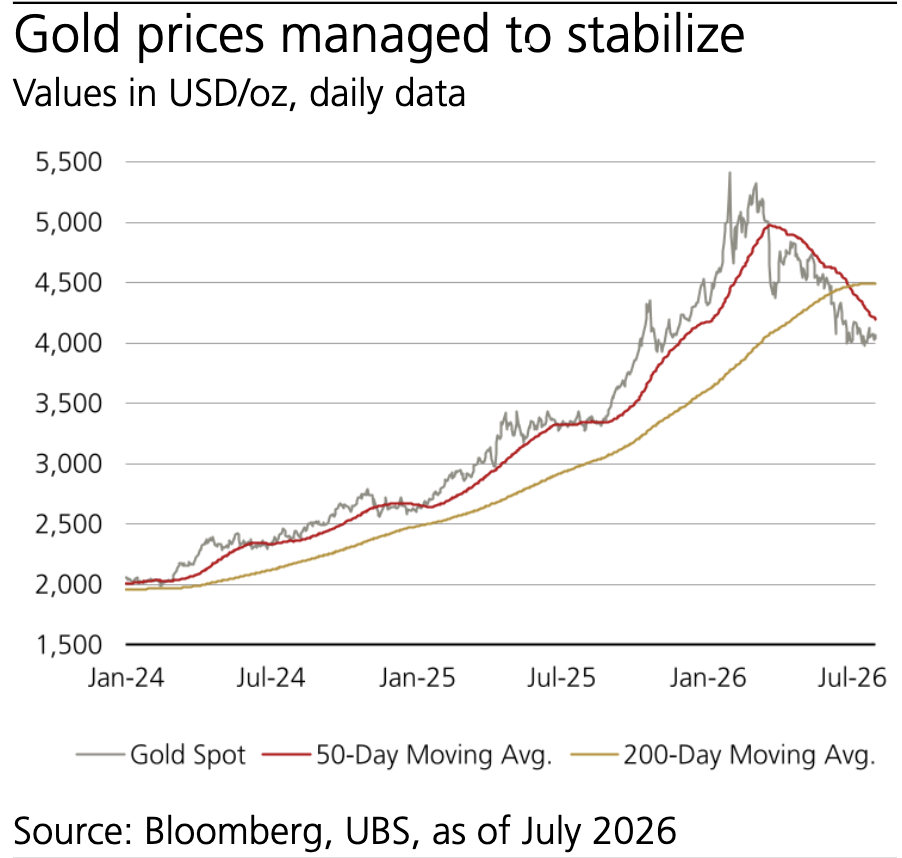
UBS’s latest gold view is constructive over the medium term but cautious near term. The World Gold Council’s second-quarter data confirm a mixed supply-demand picture: investment and jewelry demand softened, mine supply rose modestly, but central-bank and OTC demand remained strong. That combination is consistent with the price weakness seen in recent months and explains why gold did not react much to the report.
The core message is:
Gold needs sustained investment demand and robust central-bank purchases to stay above US$4,000/oz. Near-term risks remain skewed lower if markets keep pricing Fed hikes, but weakness toward US$3,850/oz should be viewed as a long-term accumulation opportunity.
1. UBS Gold Forecasts
UBS forecasts gold rising steadily into mid-2027:
Date | UBS Forecast |
|---|---|
Spot, 30 Jul 2026 | US$4,077/oz |
Sep 2026 | US$4,400/oz |
Dec 2026 | US$4,600/oz |
Mar 2027 | US$5,000/oz |
Jun 2027 | US$5,200/oz |
This is a structurally bullish forecast path, but UBS does not expect a straight-line move. They see downside risk toward US$3,850/oz in the near term if Fed hike pricing persists.
2. World Gold Council 2Q Data: Stable Total Demand, Weaker Key Segments
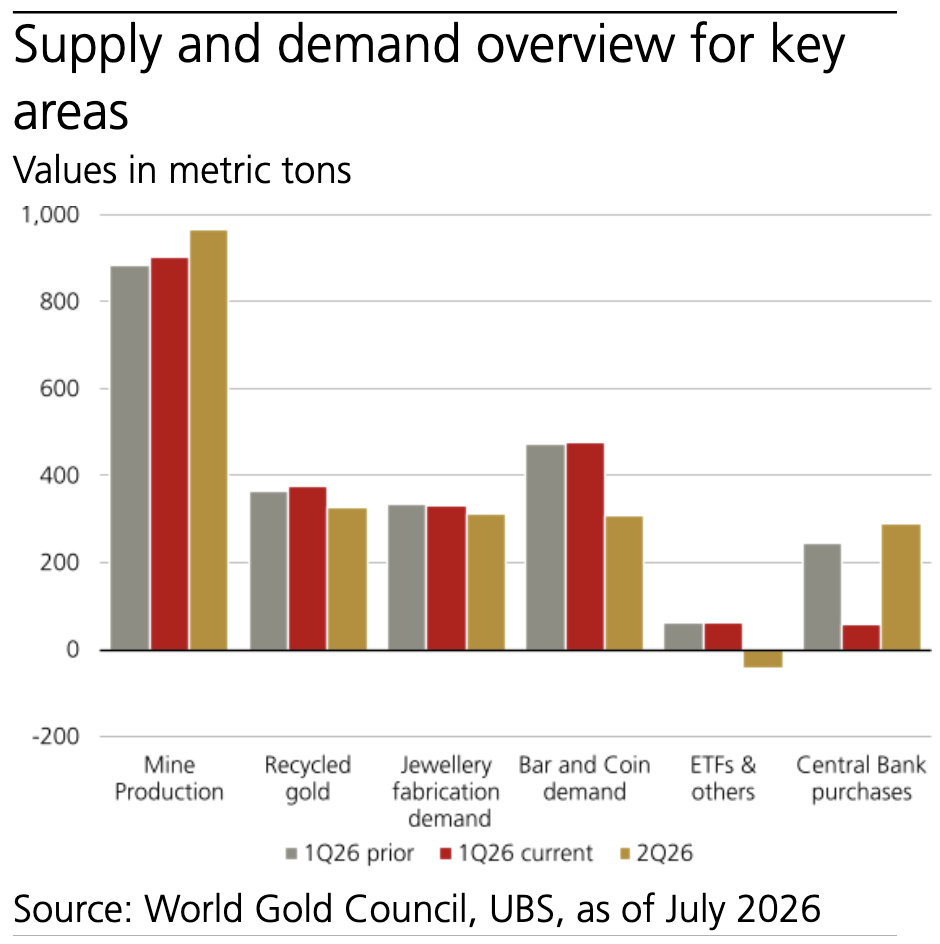
The WGC report showed stable total demand, but the composition was less favorable in some key areas.
Softer Areas
Bar-and-coin demand fell to 307 metric tons.
Investment demand excluding OTC fell to 262 metric tons.
Jewelry demand softened.
ETF holdings saw outflows last quarter.
Bar-and-coin demand was notably lower than in 4Q25 and 1Q26, when demand exceeded 400 metric tons. Those earlier quarters benefited from Fed rate cuts and USD debasement concerns. As those tailwinds faded, retail / investment demand cooled.
Investment demand excluding OTC was also much weaker than the prior year:
Metric | 2Q26 | 2Q25 |
|---|---|---|
Investment demand ex-OTC | 262t | 487t |
That is a meaningful deterioration and helps explain why gold has struggled tactically.
3. Central Banks: 1Q Revision Was a Shock, but 2Q Was Strong
The most notable data point was the World Gold Council’s large downward revision to first-quarter central bank demand.
Period | Central Bank Demand |
|---|---|
1Q26 initial estimate | 244t |
1Q26 revised estimate | 57t |
2Q26 estimate | 289t |
The revision from 244t to 57t is unusually large and weakens the near-term narrative around steady official-sector accumulation. However, the second-quarter number of 289t was very strong.
Averaging the first half:
57t+289t=346t57t+289t=346t
That puts first-half central bank demand at roughly 345–346t, implying an annualized run rate near:
346t×2=692t346t×2=692t
UBS rounds this to around 700t annualized.
That is below UBS’s full-year 2026 forecast of 750–1,000t, but not far enough below for them to change estimates, especially given the strong improvement in 2Q.
4. Supply: Mine Output Higher, Scrap Surprisingly Lower
Mine supply was revised higher for 1Q and increased in 2Q.
Supply Metric | Latest Data |
|---|---|
1Q mine supply revised | 901t, from 885t |
2Q mine supply | 966t |
2Q25 mine supply | 948t |
So mine supply rose by:
966t−948t=18t966t−948t=18t
That is a modest increase, but in a market where investment demand has softened, incremental supply still matters.
The surprise was recycled gold supply. Historically, high gold prices tend to encourage scrap selling. But recycled supply moderated:
Period | Recycled Gold Supply |
|---|---|
1Q26 | 374t |
2Q26 | 326t |
2Q25 | 347t |
This is somewhat unusual because prices remain high. UBS suggests the historical relationship between high prices and scrap supply may be partly linked to recessionary episodes, when households monetize gold during stress. Last year’s rally was driven more by other factors, so the scrap response has been less aggressive.
5. Why Gold Has Been Under Pressure
UBS argues the latest supply-demand data are consistent with recent pressure on gold prices.
The bearish near-term ingredients:
Weaker bar-and-coin demand
ETF outflows
Softer investment demand excluding OTC
Softer jewelry demand
Slightly higher mine supply
Fed hike pricing
Higher real-yield risk
Stronger opportunity-cost concerns
Gold has stabilized above US$4,000/oz, but UBS is clear that staying above that level requires both:
Sustained investment demand
Robust central-bank buying
Without those, gold can pull back toward US$3,850/oz.
6. Fed Policy Is the Key Investment-Demand Driver
The focus remains on US monetary policy and the direction of real yields. UBS’s view is that gold is vulnerable in the near term because the market is still pricing Fed hikes this year.
The gold transmission channel:
Fed Hike Pricing→Higher Real Yields→Higher Opportunity Cost→Lower Investment Demand→Gold PressureFed Hike Pricing→Higher Real Yields→Higher Opportunity Cost→Lower Investment Demand→Gold Pressure
Conversely, if the Fed stays on hold rather than hiking, or cuts rates early next year as UBS expects, investment demand should recover.
The bullish transmission channel:
Fed Hold/Cuts→Lower Real Yields→Weaker USD→ETF/Investment Demand Recovery→Higher GoldFed Hold/Cuts→Lower Real Yields→Weaker USD→ETF/Investment Demand Recovery→Higher Gold
This is why UBS is cautious short term but constructive over 12 months.
7. Central-Bank Demand Needs to Stay Strong
UBS highlights that if second-quarter central bank demand can stay close to 300t per quarter, conditions become much more supportive.
That would imply an annualized pace of roughly:
300t×4=1,200t300t×4=1,200t
That would be meaningfully above UBS’s 750–1,000t estimate and would likely reinforce the structural bull case.
However, for UBS’s optimistic path to materialize, several things need to align:
Fed holds now, then cuts over the next 12 months.
Real yields decline.
USD weakens.
Investment demand recovers.
Central-bank purchases remain robust.
Gold remains attractive as a safe-haven / diversification asset.
8. Short-Term Downside Risk: US$3,850/oz
UBS sees room for gold to pull back toward US$3,850/oz if markets continue pricing Fed hikes. This is not framed as a bearish regime shift, but as a tactical drawdown risk.
The key level framework:
Gold Level | UBS / Market Significance |
|---|---|
US$5,200/oz | UBS Jun 2027 forecast |
US$5,000/oz | UBS Mar 2027 forecast |
US$4,600/oz | UBS Dec 2026 forecast |
US$4,400/oz | UBS Sep 2026 forecast |
US$4,077/oz | Spot reference, 30 Jul 2026 |
US$4,000/oz | Key psychological / structural support |
US$3,850/oz | UBS near-term downside opportunity zone |
UBS’s tactical message is not to chase rallies aggressively here, but also not to abandon gold on weakness.
9. Strategy Implications
For Long-Term Investors
UBS views weakness toward US$3,850/oz as an opportunity to build exposure. The long-term case remains intact because:
Fed cuts are expected early next year.
Real yields should eventually decline.
USD diversification flows should support gold.
Central banks remain buyers.
Gold remains a safe-haven and portfolio diversifier.
For Tactical Investors
UBS remains cautious in the short term and prefers trading around news events. This aligns with the broader market backdrop: Fed uncertainty, oil volatility, and rates volatility can produce tactical swings.
For Options Investors
UBS says the outlook leaves room for volatility-selling strategies by selling downside price risk.
That likely means strategies such as:
Cash-secured put selling
Put spreads
Structured downside premium harvesting
Buying gold on assigned weakness
The key is that investors should only sell downside volatility at levels where they are comfortable owning gold, such as near US$3,850/oz.
10. Comparison With Prior Bull Case
UBS’s view is slightly more cautious tactically than the broader structural bull thesis, but not inconsistent with it.
Theme | Prior Structural Bull Case | UBS CIO View |
|---|---|---|
Central banks | Durable support | Strong 2Q, but 1Q revised lower |
Investment demand | Room to recover | Soft now, needs Fed hold/cuts |
APAC / China demand | Structural support | China imports strong; ETF outflows stabilizing |
Fed / real yields | Key macro driver | Near-term downside if hikes priced |
Long-term outlook | Bullish | Bullish to US$5,200 by Jun 2027 |
Near-term view | Consolidation / buy dips | Cautious; possible pullback to US$3,850 |
The main UBS nuance is that gold above US$4,000/oz cannot rely on central banks alone if investment demand continues to soften. Investment demand needs to stabilize or recover.
UBS remains structurally bullish on gold but tactically cautious. The WGC 2Q report showed softer bar-and-coin, ETF, jewelry, and investment demand, alongside modestly higher mine supply. That validates recent price weakness. The big offset was strong central-bank buying of 289t in 2Q, although the sharp downward revision to 1Q demand from 244t to 57t means first-half official demand is running closer to 700t annualized, below UBS’s 750–1,000t full-year estimate.
The near-term risk is that Fed hike pricing and higher real yields push gold toward US$3,850/oz. But UBS does not think investors should become too negative. If the Fed stays on hold rather than hiking, and cuts early next year as UBS expects, investment demand should recover, the USD should weaken, and gold can resume its move higher.
UBS forecasts gold at US$4,400/oz by Sep 2026, US$4,600/oz by Dec 2026, US$5,000/oz by Mar 2027, and US$5,200/oz by Jun 2027. For long-term investors, weakness toward US$3,850/oz is an accumulation opportunity, while tactical investors may consider selling downside volatility at levels where they are comfortable owning gold.
Disclaimer: The material provided is for information purposes only and should not be considered as investment advice. The views, information, or opinions expressed in the text belong solely to the author, and not to the author’s employer, organization, committee or other group or individual or company.
Past performance is not indicative of future results.
High Risk Warning: CFDs are complex instruments and come with a high risk of losing money rapidly due to leverage. 69% and 73% of retail investor accounts lose money when trading CFDs with Tickmill UK Ltd and Tickmill Europe Ltd respectively. You should consider whether you understand how CFDs work and whether you can afford to take the high risk of losing your money.
Futures and Options: Trading futures and options on margin carries a high degree of risk and may result in losses exceeding your initial investment. These products are not suitable for all investors. Ensure you fully understand the risks and take appropriate care to manage your risk.
Patrick has been involved in the financial markets for well over a decade as a self-educated professional trader and money manager. Flitting between the roles of market commentator, analyst and mentor, Patrick has improved the technical skills and psychological stance of literally hundreds of traders – coaching them to become savvy market operators!