Institutional Insights: CIti Global FX Strategy ' USD To Chase or Wait'

Global FX Strategy — DXY: To Chase or Wait?that markets are now pricing in a higher
Citi’s Take — Top Points
FOMC was hawkish. Warsh was not explicitly forward-guiding, but the committee was hawkish enough for markets to price more premium for a second hike this year.
USD asymmetry remains upside-skewed. Before July data, little may reverse the hawkish Fed repricing, so dollar dips should find better support.
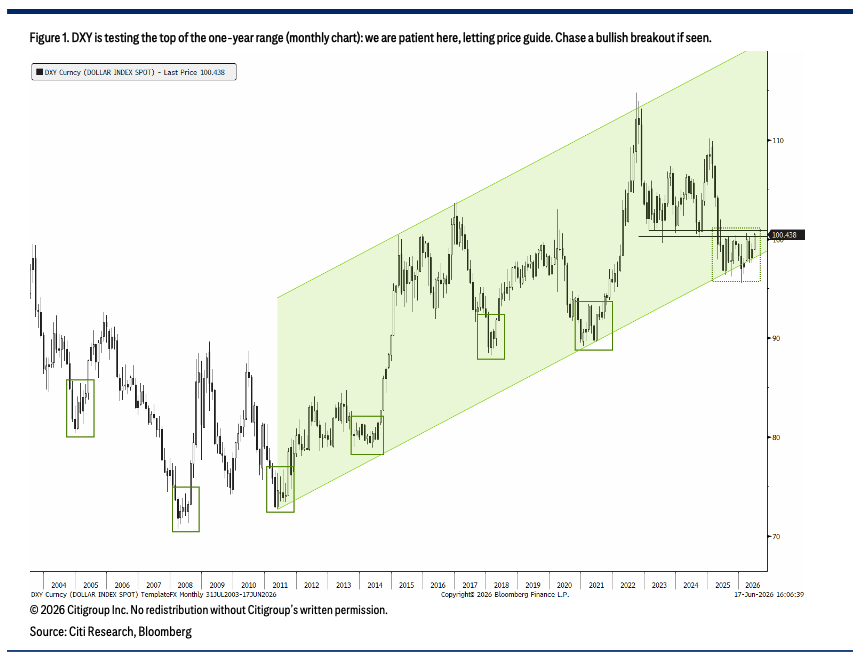
Do not blindly chase yet — use price as the guide. DXY is testing the top of its one-year range. Citi would chase a sustained break above 100.80, preferably confirmed over multiple days.
Breakout matters technically. Historically, upside USD breakouts from long consolidations after selloffs have produced meaningful follow-through. If 100.80 breaks cleanly, chase USD higher.
But patience is warranted. Front-end rates already repriced materially after FOMC, and markets may drift into a low-vol summer/soccer-tournament environment. Wait a day or two for confirmation if not already positioned.
Existing trades: Citi remains short NZD/USD and short EUR/USD.
Preferred underperformers on a USD breakout: NZD, EUR, CHF, and SEK. CHF and SEK should underperform if DXY confirms the upside break.
DXY: To Chase or Not to Chase?
The FOMC delivered a hawkish outcome.
Citi’s base case had been that Chair Warsh would stay non-committal. But the risks were skewed hawkish, and the asymmetry was USD-positive.
In the event, the hawkishness was broad enough to push the dollar into key levels.
Citi flags three hawkish developments:
The FOMC itself is hawkish.
Possibly overly hawkish, perhaps in an attempt to signal independence, but hawkish nonetheless.Trump did not criticise the Fed during the presser.
Instead, he commented in a non-critical way that Fed rate hikes are possible.Warsh pushed AI-related policy implications into the task-force review.
Those conclusions may not arrive until year-end, reducing the chance that AI/productivity arguments materially change the near-term reaction function.
Taken together, this was enough hawkishness for markets to add premium for a second hike this year.
Why Price Matters Here
The key question now is whether to chase USD strength.
Citi’s answer: let price be the guide.
DXY is now testing the top of its one-year range.
The key breakout level is:
DXY 100.80
A sustained break above 100.80 would be the signal to chase higher.
Citi’s prior framework was that if Warsh endorsed market pricing — or endorsed the idea that hikes and cuts were equally likely — the market could bring forward hike pricing and add premium for a second hike.
That is effectively what happened, even if Warsh himself avoided explicit forward guidance.
Historically, when the USD breaks higher from these consolidation patterns after a selloff, follow-through can be significant.
So if DXY breaks 100.80 on a sustained or multi-day basis, Citi would be inclined to chase USD upside.
Why Not Chase Immediately?
There are two reasons to be patient:
Front-end rates already repriced a lot.
Markets may remain in low-vol summer conditions.
That matters because the immediate hawkish impulse has already been partially priced.
If DXY stalls at the top of the one-year range, chasing now risks buying the high of the range.
Citi can afford to wait because it already has two long-USD trades on.
Existing trades:
Trade | Spot Reference |
|---|---|
Short NZD/USD | 0.5765 at 4:20pm, 17 Jun |
Short EUR/USD | 1.1498 at 4:20pm, 17 Jun |
Trading Implications
If DXY Breaks Above 100.80
Citi would chase USD higher.
Preferred expressions:
Stay short EUR/USD
Stay short NZD/USD
Consider USD longs versus CHF
Consider USD longs versus SEK
Why these currencies?
EUR: Already technically vulnerable and exposed to a hawkish Fed differential.
NZD: Weak domestic backdrop and poor forward-looking survey signals.
CHF: Low-yielder and likely funder in a calmer geopolitical backdrop.
SEK: Low-yielding funder with Riksbank still less compelling versus ECB/Fed.
If DXY Fails at 100.80
Then patience is warranted.
A failed breakout would argue against chasing fresh USD longs immediately, especially after the front-end rates repricing.
In that case, better to:
Keep existing USD longs.
Avoid adding aggressively.
Wait for July CPI/payrolls to confirm the Fed repricing.
Prefer relative-value trades and carry expressions.
Disclaimer: The material provided is for information purposes only and should not be considered as investment advice. The views, information, or opinions expressed in the text belong solely to the author, and not to the author’s employer, organization, committee or other group or individual or company.
Past performance is not indicative of future results.
High Risk Warning: CFDs are complex instruments and come with a high risk of losing money rapidly due to leverage. 69% and 73% of retail investor accounts lose money when trading CFDs with Tickmill UK Ltd and Tickmill Europe Ltd respectively. You should consider whether you understand how CFDs work and whether you can afford to take the high risk of losing your money.
Futures and Options: Trading futures and options on margin carries a high degree of risk and may result in losses exceeding your initial investment. These products are not suitable for all investors. Ensure you fully understand the risks and take appropriate care to manage your risk.
Patrick has been involved in the financial markets for well over a decade as a self-educated professional trader and money manager. Flitting between the roles of market commentator, analyst and mentor, Patrick has improved the technical skills and psychological stance of literally hundreds of traders – coaching them to become savvy market operators!